A blog about a first-time house owner learning to maintain his backyard, and thoughts about nature, science, history, and life.

Tuesday, October 23, 2012

Attracting Birds

When I was growing up, I knew quite a bit about birds.  They eat birdseed and drink water from the birdbath.  I could identify quite a few of them...even knew some of their bird calls.  Maybe I didn't know as much as I thought I did, but I did like to walk around and know what kind of bird I was looking at.

Since I've moved here, the birds that I've seen most often are crows (I hear their "cawing" all the time) and blue jays (their cries of "thief" ring through the neighborhood).  I've seen a couple of robins, some mallard ducks on the creek, and first thing in the morning there's occasionally a great blue heron around the bend.  Sometimes I'll hear the short "cheep" of a cardinal or the call of another bird that I don't recognize. But the only ones I've actually seen in the yard are crows, blue jays, and a rare robin.  This suggests to me that my yard is in an unhealthy state.  If those wildflowers and thorny plants created a suitable environment for the birds, I'd see more of them.

But there's evidence around the yard that this sorry state hasn't always been the case.  I found a suet feeder screwed to a tree:


Up to the left of the suet feeder, in the same tree, is an abandoned nest:


Two of the trees in the yard are riddled with large, round woodpecker holes.  I've heard a woodpecker hammering away while I was out in the yard, but couldn't spot the bird.  In any case, it's good to know that there are other birds around and that my backyard could be a good habitat to attract those birds, with the right modifications.

Attracting lots of birds comes down to what I plant, in my garden and in the wildflower patches.  I recently read a blog post (linked below) titled "Native Birds Like Native Plants".  Obvious, isn't it?  But what wasn't obvious to me was the variety of foods that different birds eat.  Crows and bluejays are omnivores...they eat insects and plants.  Well, crows seem to eat just about anything.  But they're the more generalized feeders, so they can survive in a relatively unhealthy habitat like my backyard (it hurts a little bit to write that!).  If I want to attract specialized feeders, I need to provide (and this is straight from that blog post):

- Berries and fleshy fruits to attract cedar waxwings, mockingbirds, and tanagers.
- Seed-producing plants to attract finches, cardinals, sparrows, goldfinches, pigeons, and doves.
- Insect-attracting plants to attract warblers, swallows, wrens, woodpeckers, titmouse, eastern phoebe, bluebird, American robin, brown thrasher, vireos, and the whip-poor-will.
- Nectar-producing plants to attract hummingbirds.

And with more birds in the yard, maybe I'll attract a few raptors such as my red-tailed hawk friends that nest a few miles away at Cornell University.  But the bottom line is that I have to be smart about what I choose to plant, so that I can draw a wide variety of birds back to my own little habitat in the backyard.  I hope that between the book that I bought at the nursery this weekend and some research on the web, I can come up with a plan for my yard that will have it bustling with new winged friends for years to come.

Source:
Native Birds Like Native Plants

Monday, October 22, 2012

A Trip to the Nursery: Meet "Shrub"


On Saturday morning, I took a trip to the local nursery, about 10 minutes away.  I've probably been to a nursery at some point in my life, but this is most likely the first time I went to a nursery and actually wanted to be there.  Now, when I go shopping, it's typically an in-and-out affair...I know what I'm there to buy, and the sooner I'm out of the store the better.  My mission in my nursery trip, though, was to take my time, browse through the plants to see the kind of selection they have, and come away with a shrub to plant along the fringe of my garden.  The nursery closes for the season at the end of October, and I wanted to have something new for the yard before then.

I browsed all of the plants, and I was overwhelmed by the selection.  This plant does well in the shade; that one is more deer-resistant.  Plants with flowers of different colors; plants that flower in different seasons.  The one thing I learned from looking at all of the plants was that if there's a popular garden plant or wildflower that I want to plant in my garden or yard, this place will probably have it.  Fortunately for me, I have all winter to research what I want to plant in and out of my garden.  After I had surveyed all of the plants, I zeroed in on the shrubs, and in particular the deer-resistant ones.  There's a family of three deer (doe and two fawns) that resides in my neighborhood, and I see them around all the time.  I don't mind them, but at the same time, I don't want them eating my first purchase.

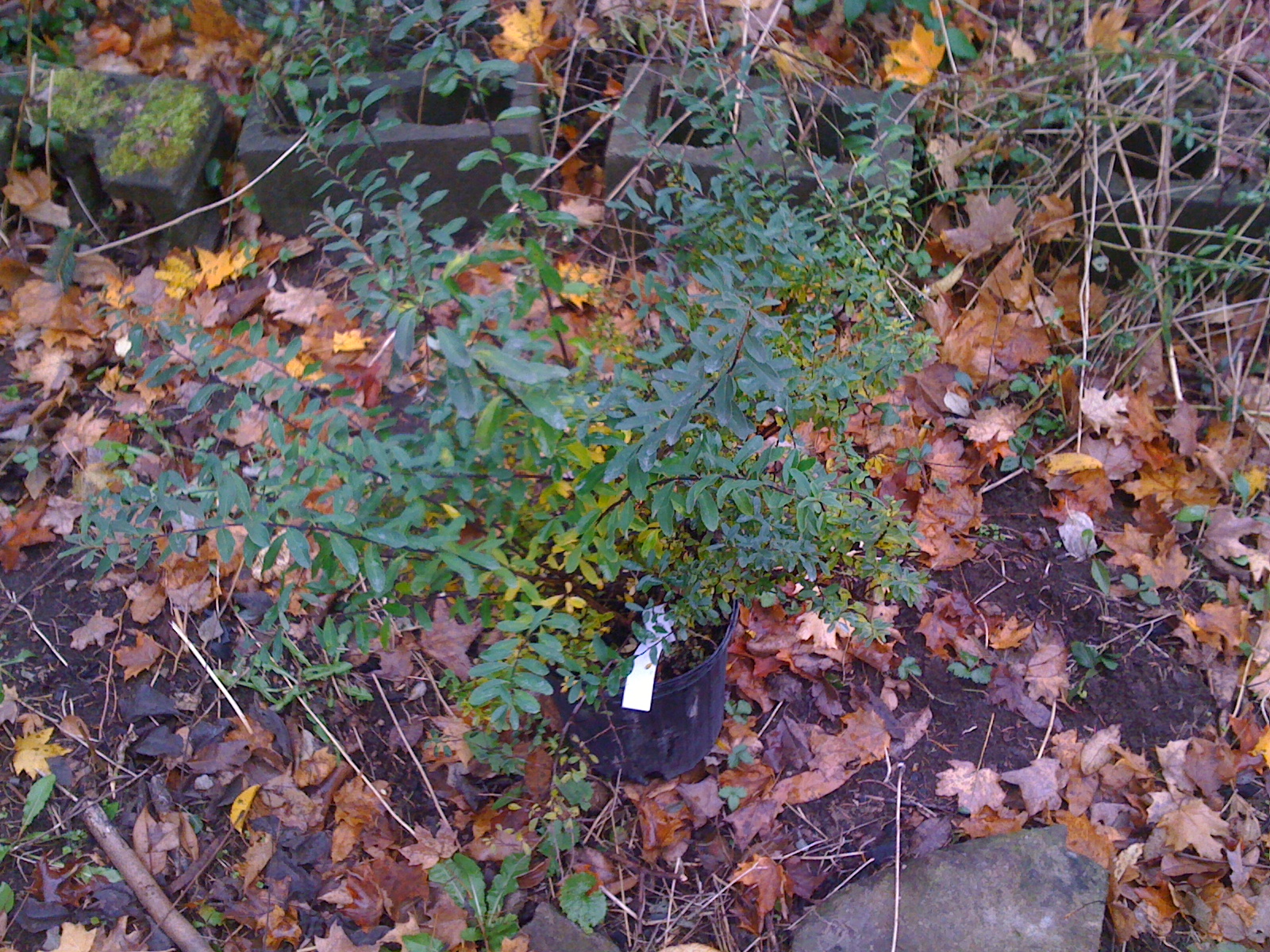
I had a shrub picked out, but I figured I'd be better off asking an expert for advice, so I got the attention of one of the nice young women working for the nursery.  She recommended a different shrub, the one that she said was the most deer-resistant.  It can also survive in a mostly shady environment, which is what a shrub needs if it's going to survive along the fringe of my garden.  Native to Japan, its scientific name is Spiraea nipponica (nipponica means "of Japan"), and it's more commonly known as Spiraea "Snowmound" for the white flowers that bloom in late spring to early summer.  And I now know more about Spiraea nipponica than I know about any other shrub in the world.


With my Spiraea (hereby dubbed "Shrub") in hand, one that was especially picked out for me by the nursery worker (she said that she looks for a plant with even growth all the way around), I proceeded to the office to check out.  I noticed a book on display, "Native Plants for Native Birds", written specifically for the Ithaca area.  I'd been planning a blog post for this week on this very topic, so I couldn't resist buying the book as well.  It will be great for my garden research this winter.


When I got Shrub back home, I took him around back, plopped him on the ground, and took a picture so the world could meet Shrub:


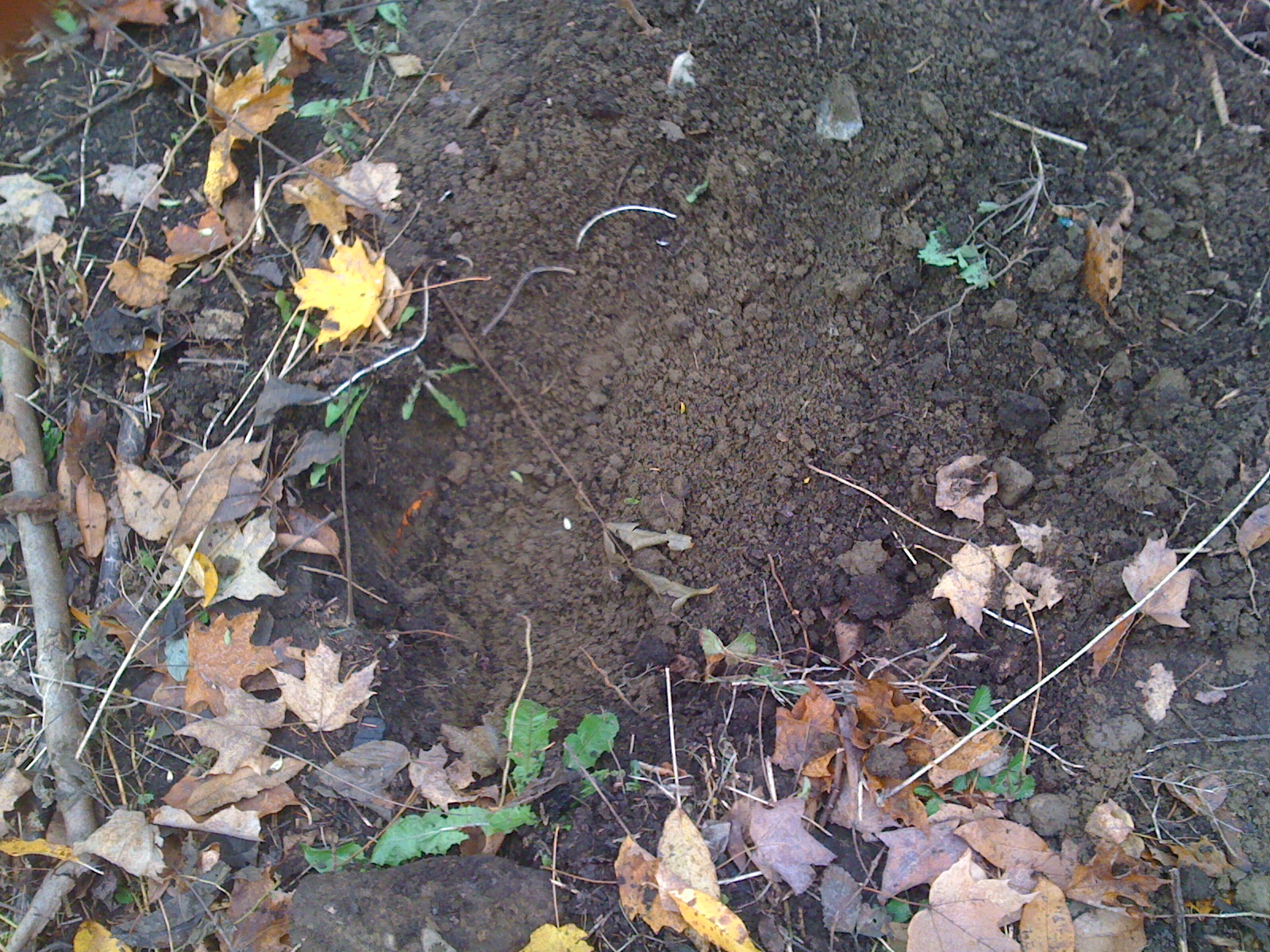
Then it was time to plant Shrub.  I don't know much about planting a shrub.  Well, I don't know anything about planting a shrub.  But I assume that, among other things, you need to dig a hole, take it out of its plastic pot, put it in the hole, and fill the hole with dirt, more or less in that order.  So that's what I did.  First, I dug a hole:


Then, I carefully extracted Shrub from his plastic pot, loosened the soil around his roots, especially near the bottom, and carefully put him in the hole:


And finally, I filled in the dirt so that Shrub was securely in place:


Now, I probably did half a dozen things wrong.  There's one thing in particular that I know I did wrong: I put him too close to one of the other shrubs in the fringe of the garden, but I realized this too late.  I'll have to move him next weekend.  In the meantime, I'll give him plenty of water and hope that the deer don't eat him.

So that's my first adventure with buying and planting something for the garden.  My parents are coming for a visit next weekend, and I'll get plenty of advice from them, since they actually know what they are doing.  In the meantime, I'll do my best to keep Shrub happy and healthy.


Sunday, October 21, 2012

Clearing the Weedy Garden: A Photo Series

While I didn't get as much raking done as I wanted to this weekend, I did finish clearing out just about all of the plants from the side of the garden that needed it the most.  Here's a look at my progress, from the beginning of the clearing project through this weekend.

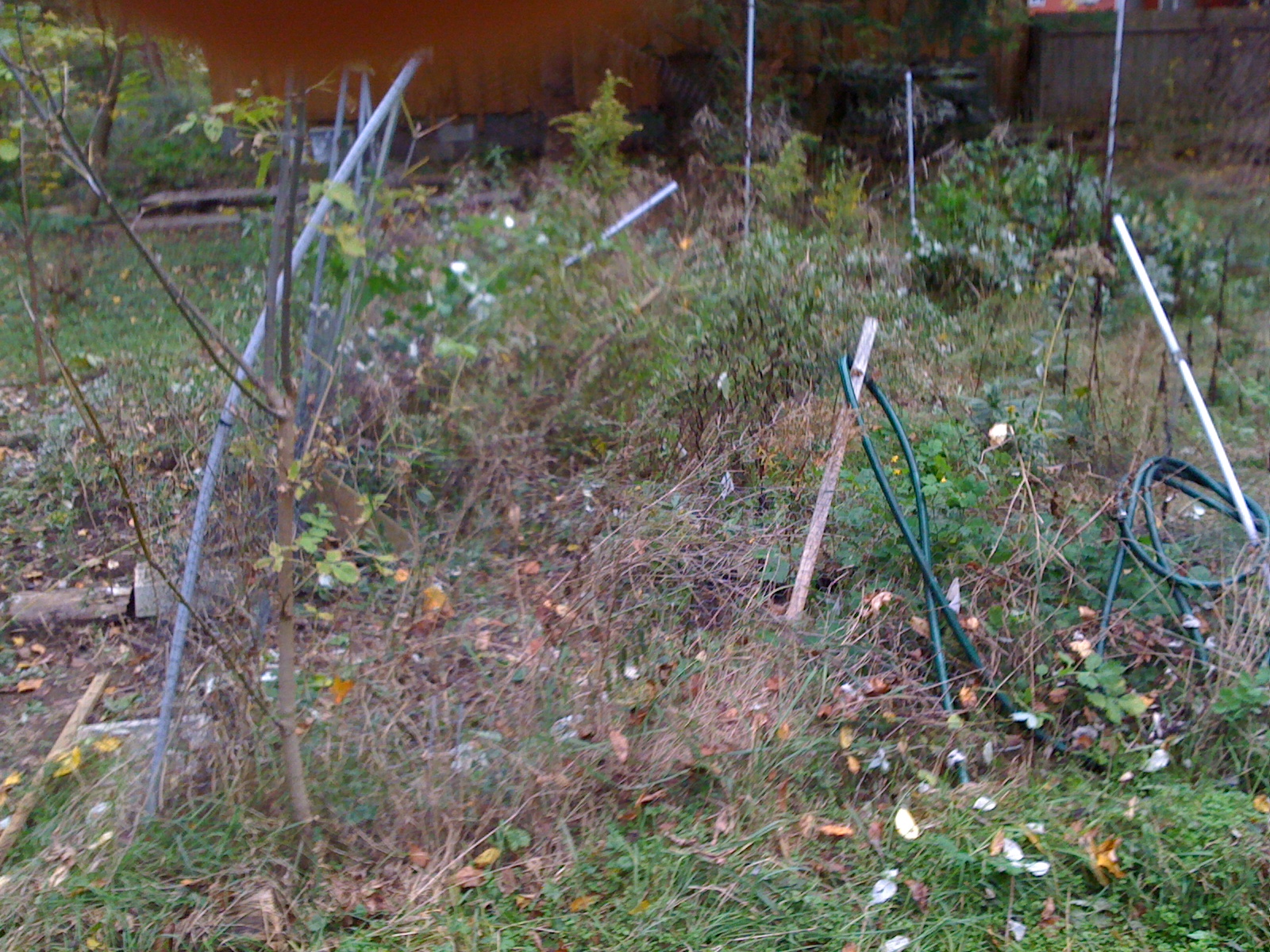
To begin with, the garden and the fringe outside the garden were overgrown with weeds.


I started at the edge of the fringe, and uncovered an entranceway to the garden.


I finished the fringe first, and left a couple of healthy-looking shrubs in place.


Next it was time to tackle the inside of the garden.  This was tricky, because along the edges, the weeds had grown right through the wire fencing.


I cleared out the pesky thorny plants first.  I didn't want to get pricked by thorns trying to get to the other plants; plus, the throny plants were the ones holding the whole thing together.


I uncovered a well-preserved piece of newspaper in the soil.  Unfortunarely, it crumbled every time I touched it, and I couldn't find a date or a point of reference to help me identify how long the garden has been out of use.


It doesn't show up too well in this picture, but this is the one and only hole in the garden that I've found to be dug by the groundhog.  There must have been something good here.


And, finally a couple of looks at the unfinished product, as of now.   The bigger plants in and next to the garden have been cleared out.  Not quite ready for planting anything yet, but slowly getting there...


Yard work plans 10/21


The good news: I spent a lot of time working in the yard yesterday.  The bad news: I spent most of that time avoiding raking.  The blurriness of this picture is pretty representative of the way I feel about raking.

In the morning, the leaves were still wet from Friday's rain, so rather than try to do anything in the yard, I drove about 10 minutes to the local nursery to check it out.  I came away with one plant and a book; more on that later this week.  After some lunch, I got outside and started moving the piles of leaves that I had raked last week and the week before to my various storage areas around the property.  I soon tired of this, though, and moved to the garden to continue clearing out the weeds.  I'll have a picture post from these efforts later this week.  I still wasn't ready to start raking, so I moved to the wildflower patch by the deer trail and began to remove the thorny plants.  I'd like to eventually add more variety to the wildflower areas in the yard, and getting rid of those pesky thorny plants is the first logical step, at least to my naive mind.  I'll have a couple of pictures of clearing the thorny plants later this week, too.  Finally, I brought the laptop outside so I could play some music and move some leaves.  I got the patio cleared, and just in time for one squirrel.

Just before writing this post this morning, I noticed a squirrel surveying the patio with a nut in his/her mouth (I'll assume it was male).  He looked at a couple of crevices between the stones before settling on one.  With me staring at him the whole time, he dug into the soil and deposited the nut into his hole, with only four feet and a glass door between us.


Squirrels are decidedly less skittish when they're trying to preserve their food for the long, harsh Upstate New York winter.


This squirrel was completely focusing on getting that nut in the ground, and he paid me no mind whatsoever.


Aftet the nut was securely buried, the squirrel covered the spot with leaves and began to scamper away.  Then he paused and turned around.  He gave the spot one last look, maybe as a reminder as to where it was, or maybe to re-assure himself that the nut was safe.

For today, I'll be outside with some tunes trying to get some raking done...

Saturday, October 20, 2012

Yard Work Plans, 10/20


Sometimes there are things that you just have to do, whether you like it or not.  This weekend, raking the leaves and clearing the lawn is one of those things.  I'm not terribly fond of raking.  Using a rake is kind of awkward, and, to me, it's really tedious.  At least with mowing the lawn, you're moving around all the time.  But rake I must, so rake I will.

One of my questions was where to put the leaves.  I don't want to bag them all and take them to the county recycling center....that would be lots of bags and several trips with my car.  I had some daylight yesterday to walk around the property and survey for areas to pile the leaves to compost.  There are plenty of places to scatter the leaves - on the slope next to the creek, in amongst the wildflowers, under the trees and next to the piles of branches.  But I think my big leaf storage/compost area will behind the shed.  This is an area that is covered mostly with dirt, not with rocks, cinder blocks, or bricks.  I have no other use for this area, so this is as good a solution as any.

Besides raking, I hope to get into the garden a little bit to bag my pile of pulled thorny plants and to clear away some more weeds.  The thorny plants in the wildflower patches are a bit more exposed and easier to get to now that most of the wildflowers have died for the season, so I may try to pull some of them out as well.  And away from my property, I'm hoping to get to a local nursery to check it out before it closes for the season at the end of the month.  Looks like it will be a busy weekend, and I'll post and update about how things are progressing tomorrow.

Friday, October 19, 2012

The Pile of Eyesore


These days, many people move to new developments in the suburbs.  Their houses are built on land that was once farmland or a natural area, and it doesn't have much of a cultural history, at least not that the homeowner can trace.

For me, though, moving into a small town that was first settled over 200 years ago, there's a lot of history on the land, and I mean that quite literally.  Because my property is right in the heart of town and less than half a mile from the site of the first mill, my plot of land has been put to some kind of use for - this is an educated guess - at least 150 years.  I also know that it hasn't been a residential property for all that time, either.  The previous owner mentioned to me that before the house was built, about 80 years ago, this was the site of a...I forget what he called it...not a factory, but something like a workshop.

As I survey the property, and especially now as plants die off with the coming of fall, I notice random junk strewn around the yard.  Some of this junk, for now, I leave in place, and some of it I pick up and move to what I call my pile of eyesore.  The pile of eyesore sits on a pile of broken concrete slabs, which were themselves an eyesore, making it the perfect place to aggregate the junk that I don't know where to put anywhere else.  Right now, the pile includes a concrete block, a piece of wood discovered in the garden, a moss-covered brick, a couple of chains, some string discovered just outside the garden, a plastic tarp, and a rusted piece of metal that appears to be quite old.


That's not all; there's even more junk around the property.  I've seen a few more moss-covered bricks and several more cinder blocks.  There are shards of broken glass (they'll be a pain to clean up!), an empty, overturned glass bowl, smashed beer cans, and discarded wrappers that I have to collect.  And then there is natural "junk" as well - piles of branches, large and small, that have been felled by the wind, and tree trunks that were never removed after the trees were cut down.  I'll eventually get to it, but for now, if it's causing no harm and it's out of the way, I'm not worried about it.

While it's all a bit ugly, the pile of eyesore represents the history of my little patch of land.  That rusty piece of metal, found in the wooded corner of the property, could date to the workshop days, and so could those moss-covered bricks.  The cinder blocks could be of some use in the garden; right now, cinder blocks line the perimeter of the garden, helping to keep the fence in place.  And even if this stuff isn't useful to me, it's interesting to think about where - and when - it might have come from.

Related posts:
Freeville History - Origins 

Thursday, October 18, 2012

Meet "Plant"


Meet Plant.  Of course, Plant consists of multiple plants, but since he's always stayed in one pot, I consider him to be one entity.  I've had to re-pot him once or twice over the years as he's grown and his roots have demanded more space.  He's probably due for another re-potting soon.  By now the roots of the separate plants are tangled together so that in a way he functions as as single organism, thriving when I water and feed him and struggling when I forget.

Plant is the closest thing I have to a long-term companion; he's been with me about a decade.  He somehow survived the dust, mold, and who-knows-what-was-in-the-air of the rather decrepit old Haus that I lived in as an undergrad, and he's survived three moves since then.  I always make sure that he's cared for when I go away for an extended period of time, and I do my best to see that he gets the light he needs every day and the water he needs every week or so.

This makes Plant probably the only proof that I have that I can handle building and maintaining a garden.  In some ways, it's a minor miracle that I've kept him alive all these years.  Not the best thing to say about my only long-time companion, eh?  Outside of school and work, I've been terrible at keeping up with long term projects.  Sure, I have hobbies that I take part in frequently, but they're also social outlets, while the garden is something more private and personal.

Or it was, until I started this blog.  Now I've begun to see how many folks out there enjoy tinkering with their yard and caring for their garden.  I'm looking at other blogs to get ideas for my own blog and to see some of the hurdles that I'll have to overcome as I work on my own garden.  I'm sharing my experiences for anyone in the world to see.  And in addition to all of my new outdoor adventures, I have to remember to keeping watering and feeding Plant too!

Wednesday, October 17, 2012

Why Are the Leaves Dull This Year?

A view from the New York welcome center on Route 81 near Binghamton,10/14/12.


I was driving through northeast Pennsylvania and central New York last weekend, right around the time of the fall foliage peak.  The hills were colorful, but unlike other years, I wouldn't say they were ablaze with color.  There was plenty of yellow and some orange, but the red was mostly missing.  The colors weren't as vibrant as I was expecting, either.  The natural question to ask is...why?

First, a quick primer on leaf color.  Most of us remember from middle school biology that leaves are normally green due to a chemical that we call chlorophyll, but it is really a combination of chlorophyll along with another chemical called carotene that does the trick.  (You might have heard of beta carotene, the chemical that makes carrots orange...same thing.)  Chlorophyll absorbs red light from the incoming solar spectrum, while carotene absorbs blue-green and blue light.  What is not absorbed is reflected, and so leaves normally appear to our eyes as green.

But as fall creeps in, a "corky membrane" forms between the branch and the leaf stem.  This cuts off nutrient flow to the leaf, and without nutrients, chlorophyll isn't replenished.  Meanwhile, the carotene, which doesn't need to be replaced, remains in the leaf.  The leaf turns yellow.  The membrane can also lead to the concentration of sugars in the leaf, presumably by cutting off their exit.  These sugars can cause the formation of anthocyanins in some types of trees, and the anthocyanins turn the leaves red.  So the key to the change in the leaves' color is apparently the formation of this "corky membrane" between the branch and the leaf stem, and the changes in chemical compounds in the leaves that result.


But as a meteorologist, I was particularly interested in why the leaves seemed so dull this year...did it have to do with the weather?  Well, chlorophyll is destroyed by low temperatures (at night) and by bright sunshine.  Anthocyanins - which produce those bright reds and purples that I didn't see on my drive - thrive in just-above-freezing temperatures, bright sunshine, and dry weather.  So, based on this, I'd expect that the weather from September to mid-October - and especially whenever the leaves were changing color - was some combination of warm nights, cloudy, and/or rainy.  But was it?

To find out, I looked at the Binghamton, NY National Weather Service office's preliminary records for Scranton-Wilkes Barre and Binghamton.  At Scranton, temperatures averaged about a degree above normal in September and right around normal for the first half of October.  A total of 17 days were clear, while the other 27 days were partly cloudy to overcast.  Twenty-one of the 44 days had measurable precipitation.  So it was relatively warm, cloudy, and rainy.

At Binghamton, the story is slightly different.  Temperatures were just below normal in September and over a degree below normal through the first half of October.  Only 13 of the 44 days were clear, and 24 had measurable precipitation.  So Binghamton was cooler, cloudier, and rainier (it rained more often, but not as much) than Scranton during this time period.

The kicker is the stretch of weather in the first few days of October...about the time that I noticed the leaves first starting to change color in my backyard.  These days (and nights) were unseasonably warm, and the warmth was accompanied by clouds and rain.  For those brilliant purples and reds to form, you need a snap of cold (but not below freezing) and sunny weather...here in central New York, you need a nice Canadian air mass to drop in for a few days.  But this year, we had the opposite in early October, and that's my guess as to why the leaves seemed a bit dull this year.


Sources/For Further Reading:
http://scifun.chem.wisc.edu/chemweek/fallcolr/fallcolr.html
http://www.na.fs.fed.us/fhp/pubs/leaves/leaves.shtm
http://www.nws.noaa.gov/climate/index.php?wfo=bgm  (weather data)

Tuesday, October 16, 2012

Fall Foliage Fotos

Here are a few pictures from the yard to show that the leaves are now past their peak...


Most of the leaves on most of the trees in my yard are yellow:


This tree has been the latest to change color:


This tree has also taken its time to turn:


The leaves in my favorite view, looking upstream from the dock, are getting pretty sparse.  Also, do you see how disturbed the surface of the creek is?  It was awfully windy this morning when I went out to take pictures.


Notice in the downstream view from the dock that all of the leaves in the foreground have fallen off just since late last week.  From the ripples in the creek, you can see that the wind was blowing from downstream to upstream, or approximately from the southwest.


Gardening Logistics


Now that I’ve started this blog, I’m getting more interested in how to make a successful garden.  And it's probably not a surprise that it’s more complicated than I thought.  Many plants, like my eating habits, are finicky.  They need water.  They need sunlight.  They need shade.  They need nutrients.  They can’t be eaten by insects, birds, groundhogs, or deer.

I’ve lived in this house for just over two months, and I’ve seen quite a few sunrises, so I have a pretty good idea where the sun comes up in the morning.  And I’ve gotten home right around sunset fairly often, so I have a pretty good idea where the sun goes down in the evening.  But I really haven’t paid much attention to how much sunlight the garden gets (or doesn’t get) during the bulk of the day.  There are trees, my house, and my neighbor’s garage, all potentially standing between the sun and my future plants.  So one of these days, I need to figure out the sun’s trajectory across the sky and from that, whether I need to plant sun-loving plants or shady plants.  And it shouldn’t be too hard to do; after all, I am a meteorologist.

Another logistical hurdle I need to overcome is how to get water from my spigot to the garden.  Much like how the internet has been purported to be a series of tubes, I need a series of hoses to reach all the way from the spigot on the near side of the house to the garden behind the far side of the house.  I suppose it’s really not that complicated.  I have a hose of my own, and a hose was left in the garden when I got here, so I suppose I just need another hose or two and a few connectors, and I’ll be all set.  But still, that’s a lot of hoses!

I'm sure this is only the beginning.  I know virtually nothing about how to plant and maintain a garden.  Fortunately, I'll have all winter to research the things I need to know, and by the spring I'll be ready to go.

Monday, October 15, 2012

First Frost


While I was away this weekend, it got cold.  Both the weather station at the Ithaca airport (5.5 miles to the west) and a weather spotter in the small town of Groton (5.5 miles to the north) reported a low temperature of 24 degrees (Fahrenheit) early Saturday morning.  Since I wasn't home to see the damage firsthand, I was curious to see what effects this first hard frost had on the plants in my yard.  After all, most of the flowering wildflowers had already died, and I wondered if there would be any left when I got back.

The results were about what I expected.  The flowering plants in and next to the garden took a brutal hit from the frost, and the flowers are wilted (somewhat visible in the picture above).  There are some purple wildflowers in the yard, though, that still look to be alive.  I'm not sure how they survived such a cold night, but it's good to know that some flowers are still hanging on in my yard.

Yard Work 10/14


I was away most of the weekend, but I did manage to get out in the yard for about an hour on Sunday.  Plenty of leaves fell while I was away, so the obvious course of action would be to rake the leaves and either bag them or pile them in the foresty part of my property.  But I had a headache, and raking the leaves has quickly become my least favorite yard activity, so I decided not to follow the obvious course of action.


I still have piles of plants that I pulled out of the ground just sitting in the garden, so I filled a bag with some of those plants.  I had some room left in the bag, so I began to clear out the garden, pulling up some plants/weeds from a random spot along the edge of the garden to fill the rest of the bag.  As seems to be the case every time I pull out plants, I uncovered a surprise.  This time it was a white wood stake that had been left on the ground.  For now, I've moved it to my pile of eyesore - the junk that I've collected from the yard that I'm not sure when/how to get rid of.  (More on the pile of eyesore later this week.)  The stake may be useful, though, so I'm planning to hold onto it.

I'm not very organized about how I go about things right now, I just want to be productive in my time outside.  I still have a large pile of thorny plants to bag and all of those leaves to deal with, but I'll get to that next weekend. An early look at the weather forecast suggests that it may be a showery weekend, but it's still early, so we'll see how things develop as the week goes on.

Sunday, October 14, 2012

The Dock: A Portrait


One of the selling points when I bought my property was its small dock on the creek below the backyard.  The creek sits about 10-12 feet below the level of the backyard; a set of steps leads from the edge of the creek bank down to the dock.  The previous dock washed away in a flood last spring, and the previous owner had it re-built just prior to my moving in.  I hope this dock lasts for years to come!

Here's a look at the dock from halfway down the steps:


And here's a series of photos showing the view of the creek from the dock, going from upstream to downstream.


Saturday, October 13, 2012

Should I Grow Vegetables?


I don't know what I'll do with the garden once I get it cleared out and ready to plant, hopefully next spring.  Part of that is because I'm not much of a gardener, which is to say, I don't have much gardening experience.  But part of it, too, is that I associate gardens with vegetables.  I'm a picky eater - the pickiest eater I know - and I only like certain vegetables.  I like corn.  I like green beans and wax beans.  I like carrots.  I tolerate broccoli and peas.  But due to my, uh, discerning tastes, I don't use vegetables, like peppers or tomatoes, in my cooking.  This makes grocery shopping easy, but it makes it pretty unlikely that I'll turn the garden into a vegetable garden.  This doesn't mean, though, that I can't use a small plot within the garden for a few vegetables.  It would be nice to eat some of my own green beans!


Acorn Place on Facebook

I've created a page for the blog on Facebook.  If you'd like to receive updates in your Facebook feed notifying you of new posts on Acorn Place, simply "like" the page.  Depending on how things go with the blog, with the page, and with my yard, there may be opportunities for readers to have a say in what I plant and how I manage my yard come springtime, via the Facebook page.  The web address for the page is http://www.facebook.com/AcornPlace.  Thanks for reading!