A blog about a first-time house owner learning to maintain his backyard, and thoughts about nature, science, history, and life.

Sunday, February 17, 2013

Hunting for Ducks at the Lab of Ornithology


I had some free time last Thursday, so I went to the Cornell Lab of Ornithology (which I briefly introduced to you some time ago) to take some pictures of birds and walk around.


Of course, I realized about two minutes after I had left the house that I had forgotten my boots. The trails were sure to be snow-covered, but I figured that by now they had melted down enough so that my sneakers would be ok.


It was a busy day at the Lab.  I parked in the outer lot, which, as you can see in the photo, was nearly 1/3 full (the other 2/3 was behind me).  The two other lots were nearly full.  I'm sure some of those cars were for employees, but there seemed to be quite a few guests in the visitor center and on the trails as well.


I posted a couple of photos of the area near the visitor center before, but much of the area is swampy.  Lots of standing water for birds (and mosquitoes!) to drink.


The Lab has over two miles of trails across its swampy grounds...in places, there are elevated wooden walks to guide visitors over the marshy areas that are too soggy to walk on.


Of course, a sign of the swampy/marshy-ness of the area is the cattail.


Here's a look at the visitor center.  This relatively new building opened in June, 2002.  Inside, it has, among other things, an auditorium, a library of bird materials, an observation area, an information desk, items for sale, and plenty of research space for the Lab's scientists.


Here's the walkway to the entrance.  As with anything associated with a major university, many items and spaces - like many of the walkways and benches on the Lab's grounds - were paid for by the generosity of donors.


Here's the view from the observation area out towards the pond.  There's a little stone beach that the birds can wander onto.  For the observers, there are a couple of high-powered telescopes to look farther out onto the pond.


And here's one thing that you can see: a large great blue heron's nest (I believe).  The Lab has cameras trained on this nest and streaming to the Web in the spring so that birders around the world can watch the young hatch and learn to fly.  (There's also a camera on Cornell's main campus, right by my building, trained on a red-tailed hawk nest.)


In the pond, near the observation area, a couple of aerators keep the surface thawed for our feathered friends to get a bath and maybe do some fishing?


On the pond this past Thursday right around noon were a bunch of mallard ducks.  It seemed to be lunchtime for them, too.


At first, I only saw a couple of ducks, but soon many more floated into view.


The ducks didn't seem to mind the cold too much.  The air temperature was a little above freezing, and the water temperature was probably about the same.


On land or in the water, the ducks were looking for some lunch.


For the ducks that climbed onto land, there was usually a lookout...just in case we pesky humans in the building were up to something.  Also of note...it was Valentine's Day, and the ducks almost seemed to know this.  They were frequently floating, swimming, or waddling in pairs.


I wonder if rocks are a good place for the ducks to find food?


This male looks to be floating reassuringly behind his mate.


And these two are looking for food (or something else?) together.  I wonder if they're looking for little insects or bugs in among the rocks?


The male here is keeping an eye out to protect his mate.  I guess these ducks, if they live here year-round, are pretty accustomed to being around people.


The ducks would occasionally flap their wings in the water, making a big splash, but it was hard to be quick enough on the trigger.


I did manage to get a couple of decent shots, though.


Look!  It's a big foray onto the beach!  But eventually, my camera was running low on battery, so I decided to take a hike.


This is the state of the trails...mostly packed-down snow with a little ice mixed in.  On some of the elevated walkways, there was more ice than snow.  I slipped a couple of times, but for the most part I was ok in sneakers and didn't mind that I had forgotten my boots.
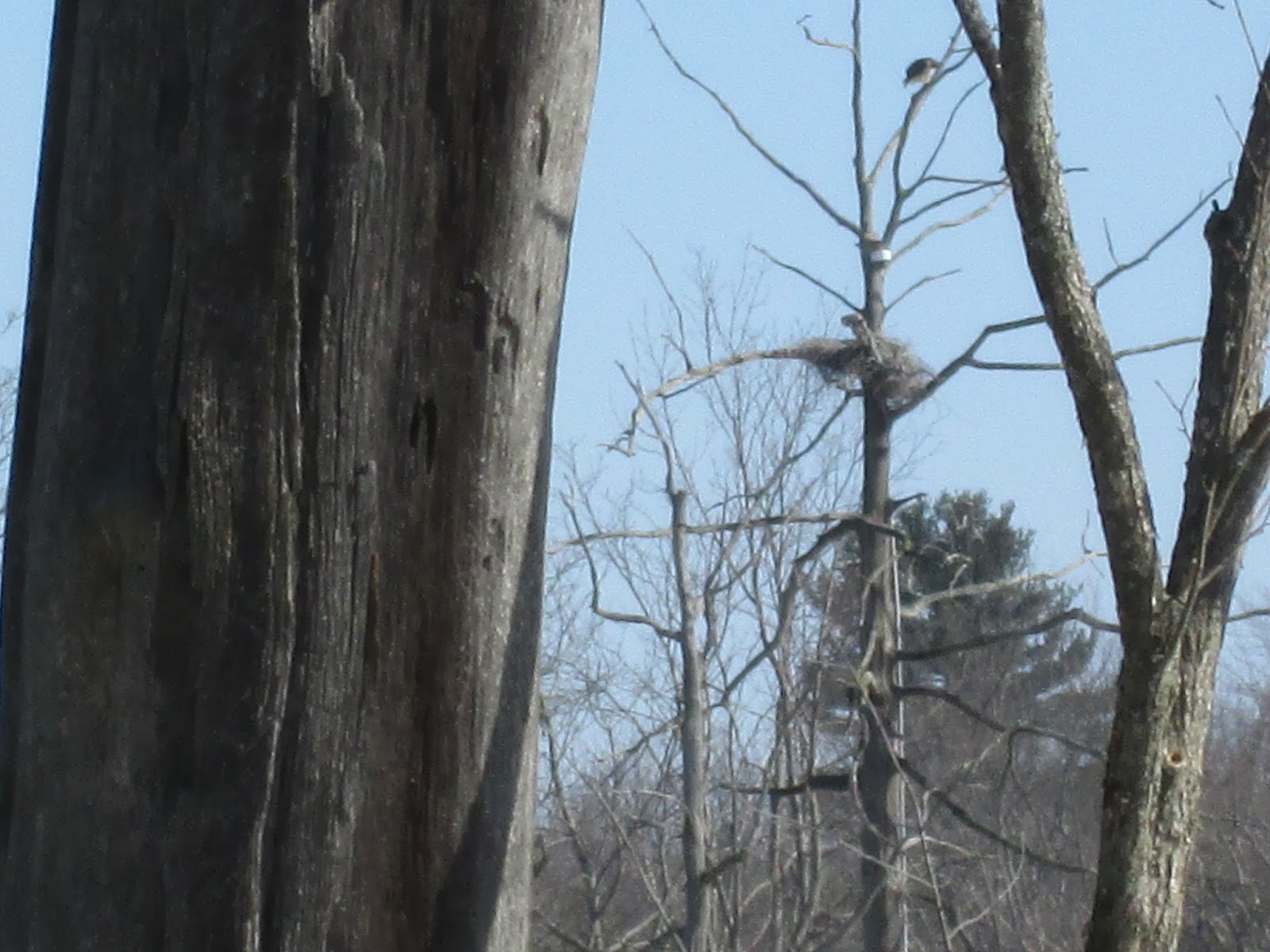

Here's the great blue heron's nest (I zoomed in a lot!) from the other side of the pond.  You can see the camera above the nest pretty clearly in this shot.  It looks like a hawk is hanging out near the top of the tree.


Here's the visitor center from the other side of the pond.  It's a fairly large pond!  The observation area is at the right hand side of the picture, and the research space is to the left.


Here's a zoomed-out view to give you a more realistic sense of the scale of things.  Can you make out the great blue heron's nest near the center of the picture?  I'm planning to go back to the Lab of O again before too long...but hopefully when it's just a bit warmer.

Friday, February 15, 2013

Great Backyard Bird Count

I generally don't see too many birds in the backyard - mostly crows, plus the occasional blue jay, sparrow, chickadee, or finch.  But this weekend, beginning today, the Cornell Lab of Ornithology, Audubon, and Bird Studies Canada are conducting the 16th annual Great Backyard Bird Count.  Rather than babble on about it myself, I've pasted the news release about the count below.  I'm going to take at least 15 minutes this weekend to see if any birds put in an appearance in my backyard.  I hope you'll do the same.

Great Backyard Bird Count Goes Global Feb. 15-18

Bird watchers worldwide invited to participate online


February 5, 2013—For the first time, anyone anywhere in the world with Internet access can participate in the 16th annual Great Backyard Bird Count (GBBC) February 15-18. Participants simply watch birds at any location for at least 15 minutes, tally the numbers of each species they see, and report their tallies online at www.BirdCount.org. The GBBC is a joint project of the Cornell Lab of Ornithology and Audubon, with Canadian partner Bird Studies Canada.

This year, anyone visiting the GBBC website will be able to see bird observations pouring in from around the world and contribute their own tallies. Global participation will be made possible thanks to eBird, a real-time online checklist program that the Cornell Lab and Audubon are integrating into the GBBC for the first time this year. The GBBC is open to anyone of any skill level and welcomes bird observations from any location, including backyards, national parks, gardens, wetlands, and urban landscapes. The four-day count typically receives sightings from tens of thousands of people reporting more than 600 bird species in the United States and Canada alone.

"We're eager to see how many of the world's 10,240 bird species will be reported during the count this year," said Cornell Lab director John Fitzpatrick. "We're looking forward to this historic snapshot of birds that that will be reported from around the world. We need as many people as possible to help build the wealth of data that scientists need to track the health of bird populations through time."
Participants will be able to view what others are seeing on interactive maps and contribute their tallies for ongoing bird research and conservation efforts. For the first time, participants will also be able to upload their counts from the field using the eBird BirdLog app for Apple or Android smartphones. To celebrate the new global reach of the count, developers of the eBird BirdLog app are offering regional versions of the app for just 99 cents through February 18. Learn more

"This count is so much fun because anyone can take part, whether you are an expert, novice, or feeder watcher," said Gary Langham, Audubon’s Chief Scientist. "Invite new birders to join and share the experience. Once you get involved, you can continue with eBird year round."

"The popularity of the Great Backyard Bird Count grows each year," said Dick Cannings, Senior Projects Officer at Bird Studies Canada, "and with the new features, participation will be even more exciting."

Participating is easy. To learn more about how to join the count, get bird ID tips, plus downloadable instructions, web buttons, and flyers, visit www.BirdCount.org. The count also includes a photo contest and a prize drawing for participants who enter at least one bird checklist online. Portions of the GBBC site are also now available in Spanish at www.ContandoAves.org.

The Great Backyard Bird Count is made possible in part by sponsor Wild Birds Unlimited

Freeville Tour: Street Names


Some time ago, I wrote a post about how people name towns.  It's really pretty similar with roads.  In rural areas, they're often named after the town or city that they take you to.  In towns, they can be named after people, places, businesses, or things.  Philadelphia set a standard for the naming of gridded streets that many towns and cities have copied since.  Going one way, the streets are numbered: First St, Second St, Third St, and so on. Going the other way, many of them are named after trees: Pine St., Spruce St., Chestnut St., Walnut St.  Many towns have followed this model in one way or another.  In New York, the gridded streets are numbered in both directions.  Going one way, it's First St., Second St., and so on.  Going the other way, it's First Ave., Second Ave, Third Ave., and so on.  I think this could get just a little confusing.

Freeville doesn't have anything resembling a grid of streets.  It's a mishmash of roads coming into town from other places and much smaller, local avenues.  The streets in Freeville are named after businesses: Railroad St, Mill St, Factory St, DPW Drive; names, as in Johnson St. and Yates St.;  towns and cities, as in Groton Ave. and Brooklyn Rd.; ideas, as in Union St. and Liberty St.; and then there's Cook St., which could be named after a person or


Freeville doesn't have anything resembling a grid of streets.  It's a mishmash of roads coming into town from other places and much smaller, local avenues.  The streets in Freeville are named after businesses: Railroad St, Mill St, Factory St, DPW Drive; names, as in Johnson St. and Yates St.;  towns and cities, as in Groton Ave. and Brooklyn Rd.; ideas, as in Union St. and Liberty St.; and then there's Cook St., which could be named after a person (either with the last name Cook or who happened to be a really good cook!), but I'm not sure.  And, of course, Freeville, like many American towns, is framed around Main Street.


Here's a look at some road signs around town.  It looks like some of the them are due to be replaced, while others look to have been replaced fairly recently!


I hope you enjoy this little look at how Freevillites...Freevillians...whatever you call us...have named our roads through the years!


Thursday, February 14, 2013

Seeds to Plant


Now I'm entering uncharted territory.  I had promised that some of my posts this winter would focus on my plans for outside beginning in the spring.  Now that we're halfway into February, it's about time that I begin to work on that.  I do have some ideas in my head as far as how to use the spaces in the yard and in the garden, but I have to decide exactly what species are best to plant.

I was at the store a couple of weeks ago, and I walked across a large display of seeds.  There were flower seeds and vegetable seeds for all sorts of plants.  I decided to pick up an "Annual Cut Flower Mixture" for the planter areas in front of the house.  I want to plant mostly annuals rather than perennials this year because I figure it will take at least a couple of years of experimenting to work out plant spacing and figure out what kinds of plants look good in each space.  I don't want to be planting too many perennials in my first year only to dig them up a year or two later because they didn't work out for one reason or another.

The "Annual Cut Flower Mixture", according to the seed packet, is "a colorful blend of American's favorite old-fashioned flowering annuals. Some bloom early, some late. There are tall spike flowers, others with round blossoms, and airy sprays of filler flowers."  This sounded like a good mixture for a first season of planting.  According to the packet, I should plan to plant them between May and June, and they'll grow best in full sun.  Now, they're not going to get full sun in front of the house (or anywhere else in the yard), but I hope they get enough that they'll come up.

I know nothing about flowers, and I only recognize a couple of flowers in the mix, but if you're curious, here they are: "Strawflower, Aster-Crego Mixed, Calendula-Single Mixed, Plains Coreopsis, Bachelor Button Mixed, Clarkia, Cosmos-Sensation Mixed, Chinese Forget-Me-Not, Larkspur-Giant Inperial Mixed, Gypsophila-Elegans White, Corn Poppy, Black-Eyed Susan, Marigold-Crackerjack Mixed, Zinnia-Cactus mixed, Godetia"

Now that I have something to plant out there, I'm ready for spring!

Wednesday, February 13, 2013

Weather-Related Articles

Here are a few (mostly short) weather and climate articles that I've pulled from around the web.  All of them were interesting to me, so I hope that you'll find at least a couple interesting to you.

Greenhouse Gases Affect Rainfall Differently Than Natural Global Warming

Scientists used computer models to show that precipitation during modern-day global warming has increased less than precipitation during warming that occurred during the Medieval Warm Period between 950 and 1250 AD.  Read the article for a brief explanation as to why.

Afforestation can mitigate climate change locally

"Planting deciduous trees in tree-deficit areas could bring about cooler and wetter summers and mitigate effects of climate change in temperate zones [i.e. the mid-latitudes], says a new research."  The punchline: planting trees leads to more evapo-transpiration, which cools the air near the surface.  Read this short article for a more complete explanation.

NASA Captures Solar Flux Rope, CME Precursor Seen For The First Time On Its Own

Solar storms can produce Coronal Mass Ejections (CMEs), large ejections from the Sun's outer atmosphere that can, in the worst cases, affect telecommunications and even electronics on Earth.  Flux ropes have been thought to occur before a CME, but they haven't been observed until recently.  The article's a little technical, but interesting nonetheless!

The Tornado Damage Scale In Images

This one, as the title says, is just pictures of tornado damage, with short descriptions.  Have you ever wondered about the difference between an EF-0 (EF stands for Enhanced Fujita, a recent revision to the old Fujita scale) and a relatively rare EF-5 tornado?  The pictures show the dramatic difference.

Rain tracked with mobile network

I found this story to be really neat.  Ordinarily, we track rainfall with weather radar.  But in some places, like Africa, we don't have radars in place.  This limits our ability to study rainfall in these places.  But this study used cellular phone signals, which are weakened in the rain, to produce maps of estimated rainfall.  The maps wound up being pretty accurate.  Even parts of Africa have cell phone coverage, so this could be a useful technique for improving our knowledge of rainfall in places where our understanding is currently limited.  Of course, there's more detail in the article.

Sahara: Life giving sands

This is a short (4-minute) video showing how sand from the Sahara is transported across the Atlantic to the Amazon jungle in South America, where it helps to support one of the most diverse habitats on Earth.  Some breathtaking images in this video!

Tuesday, February 12, 2013

Photo Series: More Images from the Snowstorm


Snowstorm Names

You may have noticed that when I referred to this weekend's snowstorm, I didn't use the name that has been popularly ascribed to it.  The Weather Channel has taken it upon themselves to name storms this year, and I don't agree with their methods.  Most of my arguments are stated pretty clearly in the article below.  In short, I find the naming thing to be more of a publicity stunt than a legitimate effort to aid the scientific community and the public.  I do agree that major winter storms would be easier to remember if they had catchy names rather than "Superstorm of 1993" and "Blizzard of 1996".  But I think the naming convention needs more study rather than flippantly choosing names and selecting random criteria for when to apply them.  It's a problem that could use the input of social scientists, much like the way that the research project that I've recently proposed, involving a team of scientists and social scientists, proposes to integrate social science as a guide to direct more fundamental scientific research.  If you have a couple minutes, please check out the article link to read more about how meteorologists feel about the naming of winter storms.

Finding Nemo Article

Monday, February 11, 2013

A Surprising Visitor


After a couple of long posts over the weekend, just a short post tonight. At one point when I was in the living room this weekend, a little furry fellow appeared on the rug.  I don't know where he came from...whether it was within the house or outside, but he was clearly seeking a warm home until he transitions to a butterfly or moth.  I didn't have the heart to kill him, but I didn't really want him around the house, so I took him outside in hopes that he could survive the rest of winter and live on.