A blog about a first-time house owner learning to maintain his backyard, and thoughts about nature, science, history, and life.

Tuesday, February 5, 2013

Photo Series: The Frozen Creek


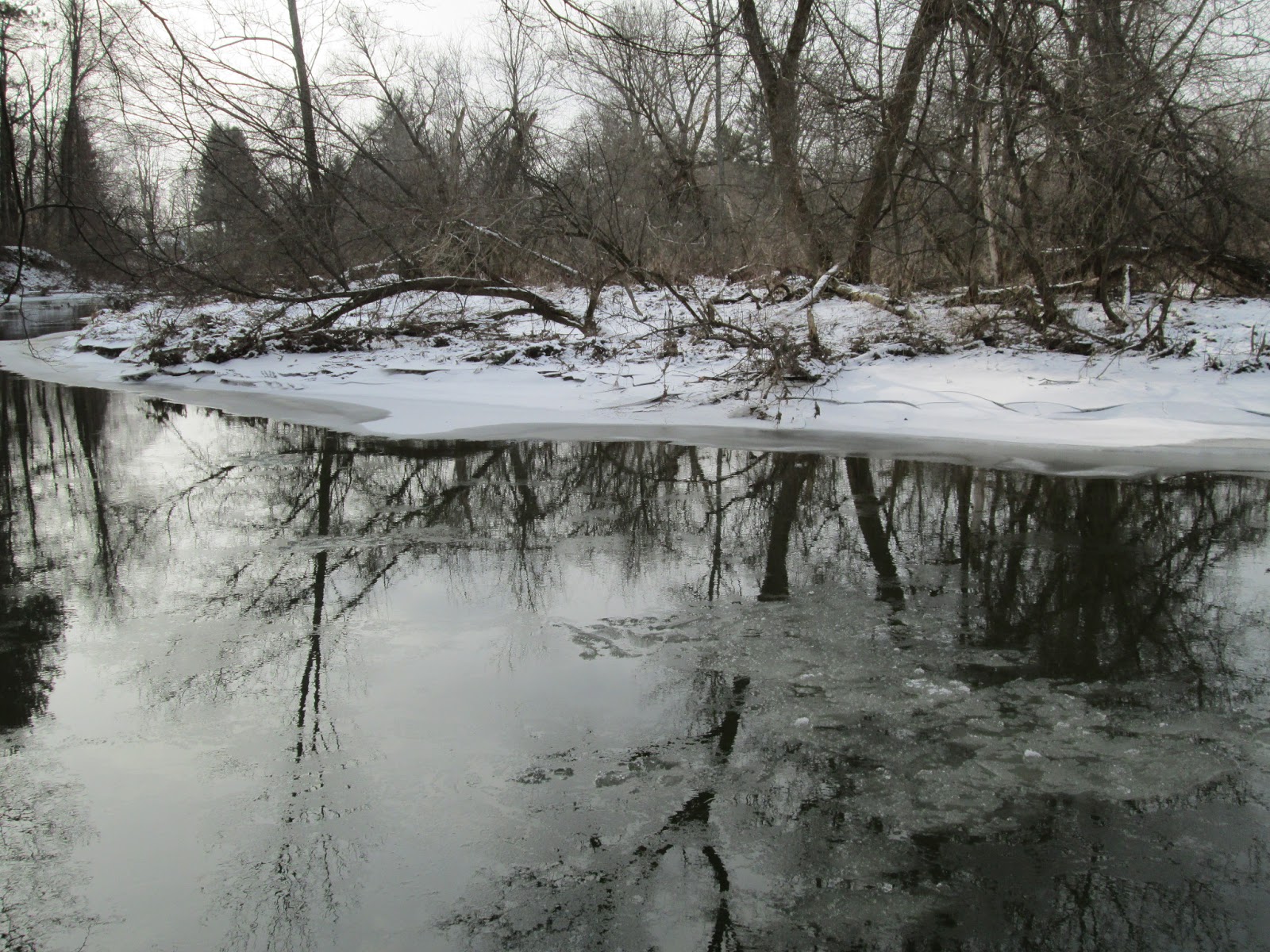
Between January 22 and January 28, it stayed below freezing.  Between the 23rd and the 27th, highs didn't get out of the teens.  The 24th was the coldest day, with a high of 11 and a low of -6.  Temperatures hovered in the single digits for most of the day, and for much of the week.  During this time, the creek completely froze over.  It was running fairly high prior to this, so the ice partially dislodged the dock, as you can see in some of the photos below.  With an ice-covered creek, snow accumulated on the surface.  I've read about the olden days, when this happened regularly, and folks - especially kids - would go ice skating on the frozen creek.  I wasn't brave enough to test the strength of the surface, but I did wander outside and brave the cold temps to take some photos.


National Weatherperson's Day

Since I'm both a meteorologist and a trained spotter, I figured I'd share this, which I've shamelessly stolen and re-posted from the National Weather Service Binghamton, NY's Facebook Feed:

"It's National Weatherperson's Day! This day recognizes individuals in the fields of meteorology, weather forecasting and broadcast meteorology, as well as volunteer storm spotters and observers. It is observed on the birthday of John Jeffries, one of the United States' first weather observers who took daily measurements from 1774 to 1816. (source: Wikipedia)"

Monday, February 4, 2013

Footprints, Part 2

1

One of the neat things about snow is that it allows you to track the movements of animals and people through the yard.  When the snow is only an inch or so deep, as it has been over this past weekend, it doesn't impede the movement of the animals, but it becomes very easy to follow their movements.  Can you guess which animals made the prints in the photos in this post?

2

3

4

5


Answers: (1) Deer, (2) Cat, (3) Crow, (4) Dog, (5) Me!


See also: Footprints

New Snowboards


My old snowboard was pretty lightweight, and it either blew away in the strong winds last week or was removed from the yard by someone or something.  In any event, I had to replace it, so I stopped by a local arts and crafts store when I was out running errands on Sunday.  I picked up a three-pack of 14" by 18" canvases.  They're a little heavier and more durable than the old snowboard, so I hope that they'll hold up better.  I can also do a better job of bringing them inside after the snow hits to keep them from being blown around or tampered with.  The advantage of having three snowboards is that I can distribute them around the yard and get a better sampling of the snowfall.  I managed to get one of the boards in place right after I got home, and I measured 1.8" of lake effect snow that fell mostly during the Super Bowl.   Before the next significant snow event, I'll find a couple of strategic spots for the other two snowboards.

Sunday, February 3, 2013

Scenes from the Yard

See the stick in the lower right hand quadrant of this photo?  It marks where my snowboard used to be.  With the high winds we've experienced in the last couple of weeks, it must have blown away.  I'll have to stop by the arts and crafts store today and pick up another (sturdier?) snowboard.

Thanks to all of the wind, there are a lot of twigs down across the yard.

The wind was strong enough to fell some larger branches, too!

I strolled down to the dock to take a gander at the creek.  The ice is thicker than yesterday, and it extends farther out into the creek.  There's still a parade of small ice floes.  I'm not sure where they come from, but I did see one bob to the surface.

The fringe of the ice looks like a series of waves has passed over it, but I think the reality is more likely that the ice accumulates underneath the surface, and that these rifts are due to wave action from below.

Yesterday, the branches of this tree reached down to the water surface, where they were holding onto small bergs of ice.  It looks as though the branches were snapped off sometime in the last 24 hours.  Also, notice how the thin ice floes on the surface of the creek tend to move right along the icy edge as they pass through the bend near the dock.  The middle of the creek is ice-free in the photo above.

Looking across the creek, the fringe ice has extended on that side, as well, and there is a series of rifts in the ice near the water's edge.

See how much thicker the ice has gotten?  I don't think it's anywhere near thick enough to stand on.  Also, notice the wave-like rifts near the water's edge.

We had a very hard freeze a couple of weeks ago, when temperatures struggled to get out of the teens.  We spent the better part of a week in single-digit temperatures, and at night below-zero temps were common.  The creek froze solid (I'll have pictures in the coming week), and the dock was literally bent out of shape because the water was running high at the time.  In the photo above, you can see how the corner of the dock at the upper right was warped.  The dock is still stable, and I don't think this will have any long-term ramifications for my ability to use it.

Disasters and Risk

I'm sharing a couple of older (2-4 weeks old) articles today.  This one looks at the costs of disasters, especially in the U.S.  The U.S. was hit hard in 2012, especially by a widespread drought that affected farmers over much of the central part of the country and Sandy, which set a course for the most populated corridor in the country.  The result?  90% of the world's disaster costs in the world were borne by the U.S.  At the same time, coverage of climate change in the media dropped a bit from 2011.  Sticking one's head in the sand never solved any problems....it's about time that we face the reality that disasters like this are inevitable, and that climate change is only stacking the deck in their favor.

U.S. hit with 90% of the world's disaster costs in 2012 

Shift in Politics of Disaster Aid

Whose responsibility is it to fund the re-building that must happen after a natural disaster?  It either falls on the government or on individuals and charities.  Either way, insurance companies bear some of the burden, but they can't afford to pay for everything, and government pretty much has to step in to some extent...the costs are otherwise too much to bear.

In the wake of Hurricane Sandy, some politicians are standing up to the status quo.  The way I read the article, Democrats tend to push through massive legislation with massive overspending in response to disasters, and some Republicans are getting tired of this.  Rather than approving the legislation for Sandy relief, they're voting "no" in hopes that they can get a streamlined recovery bill through Congress.  This is my interpretation of the article, anyway.

Give it a read yourself, it's short!

The Politics of Disaster Aid Are Starting to Shift

Saturday, February 2, 2013

Meet "Bill"


Sorry, you can't actually meet Bill in this post.  I don't have a picture of him, because he scampers away every time he sees me.  He's a flighty little fella.  But today's as good a day as any - well, really, a better day than any other - to introduce you to Bill.  Bill is a groundhog, and he seems to spend quite a bit of time on my property.  One of his hideouts is under my shed, and I've seen him in the garden a couple of times.  He's done some digging in the garden, but I have no idea what he's found (or hidden) there.


I think Bill is spending the winter on my property as well.  Groundhogs hibernate during the winter, according to Wikipedia, which would explain why I haven't seen Bill in a few months, and why he probably didn't emerge from his burrow this morning to check whether he could see his shadow.  It was a partly cloudy, partly sunny morning, so if Freeville Bill had emerged, and if the remainder of winter were predicated on whether he saw his shadow or not, it would be a toss-up.


Why did I name him Bill?  Well, that one's pretty easy.  My parents had a groundhog that lived under their deck and tore up their yard.  They named him Bob.  So picking a name starting with a B was pretty straightforward.  But I went with Bill because I have an uncle with that name.  Uncle Bill happened to be born on Groundhog Day.  And if I do say so myself, with his round face and moustache, Uncle Bill bears some resemblance to a groundhog as well.  So it was only natural to name him Bill.

Happy Groundhog Day!


Photo Series: The Icy Creek

The creek has dropped below the level of the dock again, after submerging the dock and the first step earlier this week.

Notice how the bottom step has a bit less snow than the step above it.  Also, some ice was left behind after the water receded below the dock.

As I've noticed when the temperature drops well below freezing (to the upper teens when I went outside this afternoon), the edges of the creek freeze over first.

Small areas of surface ice floated by.

The surface ice was broken up by rubbing against the sturdier ice along the edge of the creek.

As you can see, the creek carried a train of these thin patches of ice along the surface.

The ice ringing the creek extends from the bank up to three or four feet into the creek in places, while in other places, the ice is only a couple of feet wide.

The opposite bank also had the ice extending into the creek.  With temperatures slated to remain below freezing until the end of next week, the ice cover will be expanding on the creek.


The steel cable that holds the dock in place is still caught in the ice.

The ice dangling over the bank shows how high the water was at one point - a few inches above its current level.


It looks like the tree branches in the photo above provided a stable platform from which stationary patches of ice could form....the water just slid on by.

Friday, February 1, 2013

Busy As A....


When I went back to the creek to see how high it was running the other day (going back there for the first time in almost a week), I discovered the scene above.  A tree or shrub had been cut down - presumably by a human with a tool, not by a beaver with its teeth.  At one time, Fall Creek was dammed in several places by ambitious humans with mills, including the one that I've posted about a few times on this blog.  But for centuries or even millennia before that, the creek had been dammed by beavers.  There was lots of life along Fall Creek, and this attracted humans....not as a place to settle permanently, but a place to visit for the hunt.  Long after after the Cayuga had established this as part of their territory, , the French and English fur traders penetrated what is now the Freeville area.  They sought the furs of not only beavers, but also foxes and minks.  Now, the mammals that I see around here are limited to deer, skunks, the occasional dead opossum on the road, and a couple of feral cats.  I know there are foxes in the area (a friend recently spotted one at her home a few miles away), and I've heard coyotes howling in the night just south of Ithaca, not too far away, either.  But the hunters and subsequent settlers seemed to have wiped out the beavers and the minks.  It's a shame they aren't around here any more.

Note: Click on the "history" tag below to read other entries in the Freeville history series.

Wild Weather Day


We experienced a sudden warm-up here in central New York earlier this week.  Temperatures were warmest late on Wednesday afternoon, topping out at nearly 60 degrees.  It stayed warm through the evening and well into Wednesday night, until the arrival of the cold front sent temperatures plummeting between and 3:00 and 4:00 am.  At the Ithaca airport, a few miles from my house, the mercury dropped from 53 to 43 in an hour (or less), and the drop was even more dramatic at Cornell's weather station, from 53 to 40 within the same hour.


The rain moved in around 8 pm last night, and a light to moderate rain lasted all night and into the morning.  In all, there was 1.35"of rain (and one pine needle) in my rain gauge in the backyard when I checked it this morning.  That's quite a bit more than at the Ithaca airport.  I had made the mistake of not checking it yesterday afternoon before the rains started and I had been out of town for a few days, so it's possible that last night's rain was less than that.


The creek was higher than I've seen it so far.  The dock was submerged by, I'd guess, nearly a foot of water.  The bottom step was submerged by a few inches of water.  The creek was swollen.  Downstream, in an area where the bank is virtually flat, right near the confluence of Virgil Creek and Fall Creek, the water had spilled out of the banks and onto the surrounding grass.  The roads and buildings were far enough away as to be unaffected.


In any event, sometime after 7 am, the rain transitioned to a brief period of granular snow or graupel (see first photo of the post).  There was a light coating on the ground.  We had some flurries over the course of the day, but the winds (and perhaps more accurately stated, the wind shear) seemed to be too strong for sustained lake effect snow. 
 

The winds picked up early Wednesday in advance of the cold front, but the strongest winds arrived today in its wake.  Around 1:00 this afternoon, the Cornell station recorded a maximum gust of nearly 40 mph, and sustained winds were steady at about 20 mph for most of the afternoon.  I stood outside for about 10 minutes late this afternoon, and that was more than long enough.  With a temperature around 30 and winds of 20 mph, the wind chill was about 17.  It felt pretty bone-chillingly cold, though...much like it did last week when temperatures hovered in the teens.